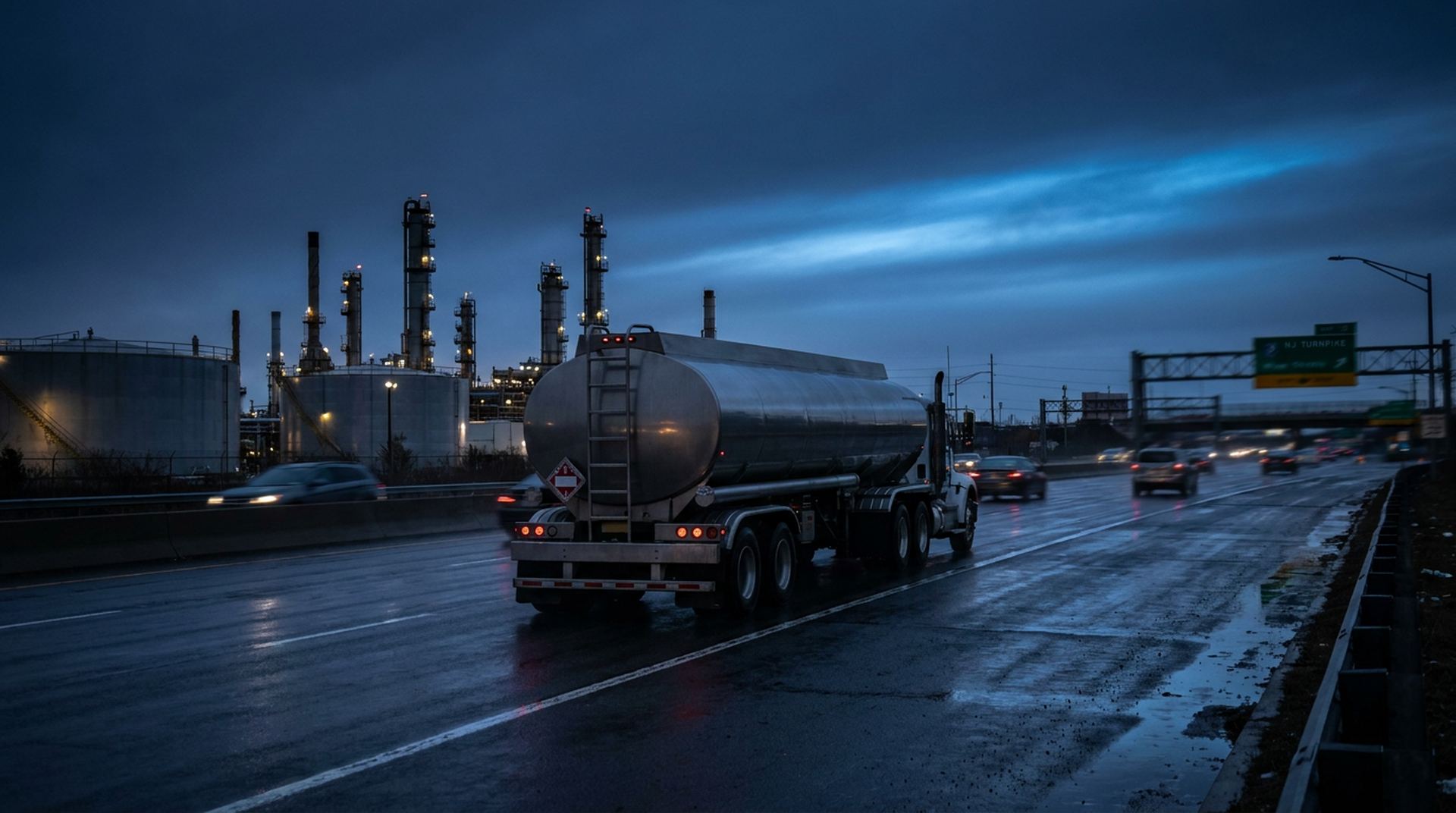
Yes, a fuel or chemical load changes your case. The truck must carry more insurance, often $1 million or $5 million. More companies and agencies are involved. And when vehicles burn, the case is built from State Police, DEP and County Hazmat records and the carrier's electronic data.
Garces, Grabler & LeBrocq, P.C. · Edison · New Brunswick · Perth Amboy · AVAILABLE 24/7
127
cargo tanks among the 4,102 truck and bus vehicles in Middlesex reportable crashes (3.1%), in 126 crashes
2021–2025, FMCSA crash file
21
Middlesex crashes flagged with a release of hazardous material, 13 of them in 2024
2021–2025, FMCSA crash file
394
active hazmat-registered carriers based in Middlesex County
FMCSA carrier census, pulled September 2026
$5 million
federal minimum liability insurance for bulk hazardous substances in cargo tanks and the other listed classes
49 CFR 387.9
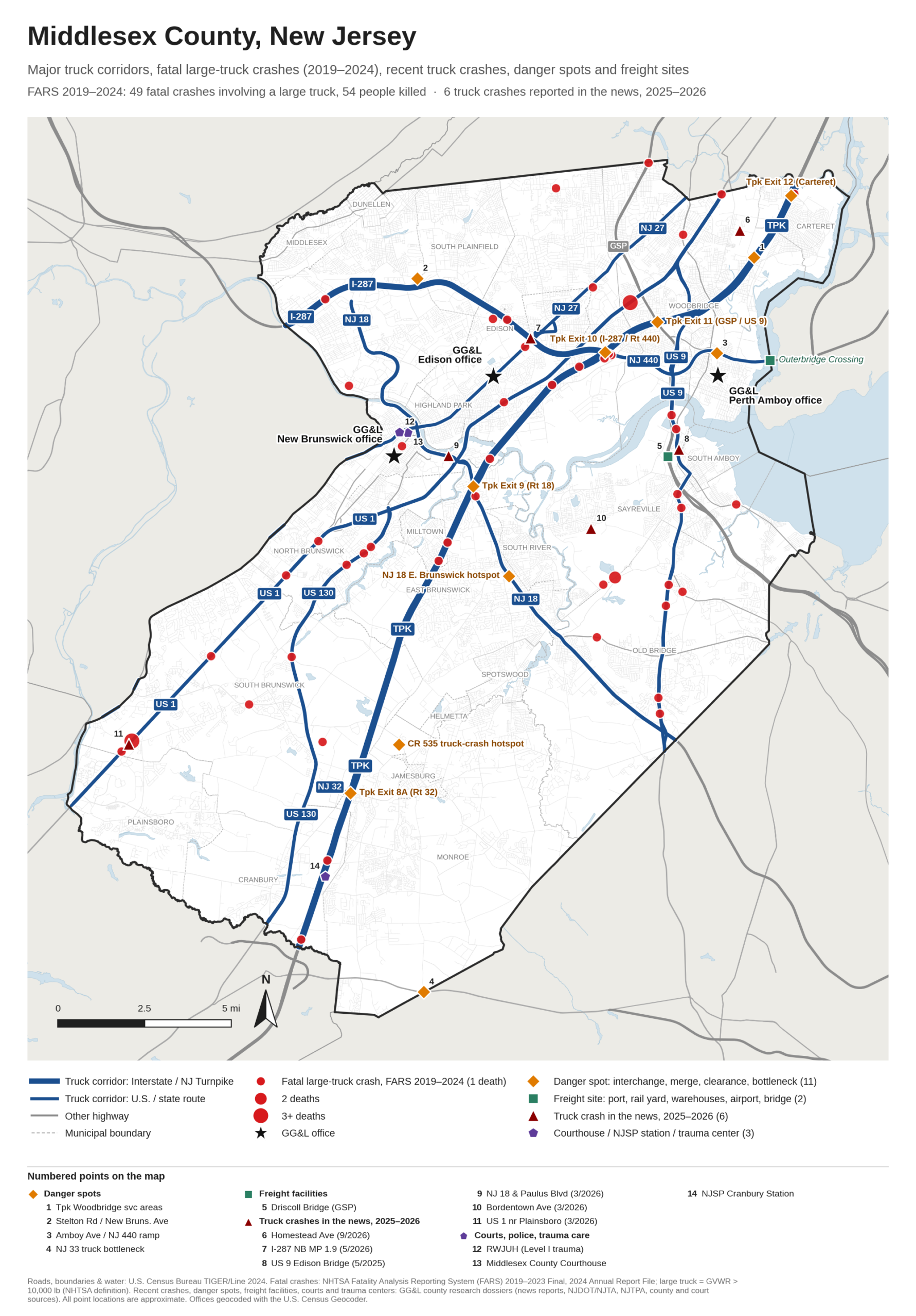
Middlesex County sees these crashes on I-287, US 9, US 1 and the Turnpike. This page covers what happened, what the data shows, which insurance tier applies and where the evidence lives. Garces, Grabler & LeBrocq, P.C. gathers it for you.
May 17, 2026, I-287 northbound at milepost 1.9, Metuchen. A passenger vehicle rear-ended a tractor pulling a fuel tanker. All three vehicles burned and two people died. The New Jersey State Police investigated, and the state Department of Environmental Protection and Middlesex County Hazmat tracked fuel runoff from the scene. FMCSA also logs this crash in its file, with two killed.
February 11, 2023, US 9 near Frederick Place, Sayreville. A collision involving a fuel tanker closed Route 9 in both directions while County Hazmat transferred the fuel out of the damaged tank.
September 2, 2026, Homestead Avenue, Woodbridge. This was a box-truck underride rather than a tanker crash, but it brought County Hazmat anyway: the truck’s ruptured saddle tank leaked diesel. A release of hazardous material can come from any truck’s own fuel, not only from the cargo.
In the fatal-crash record, two Middlesex crashes from 2019 through 2024 involved a cargo tank, and both were flagged as hazmat loads. One was an overnight Turnpike crash in 2019, in rain, in which the tanker jackknifed and its driver died. The other was a daytime crash on US 1 in Woodbridge in 2021 in which an occupant of another vehicle was killed (NHTSA FARS).
Cargo tanks among truck and bus vehicles in reportable crashes
127 of 4,102 (3.1%), in 126 crashes
2021–2025, FMCSA crash file
Roads named most often in cargo-tank crashes
US 9 19 · US 1 19 · Turnpike 19 · I-287 8
2021–2025, FMCSA crash file
Crashes flagged “hazmat released”
21, of which 13 were in 2024. Only 4 of the 21 involved a cargo tank, so most releases came from other truck types, which can include a truck’s own fuel
2021–2025, FMCSA crash file
Fatal large-truck crashes involving a cargo tank
2 of 49, both flagged hazmat
2019–2024, NHTSA FARS
Active FMCSA carriers based in Middlesex registered for hazmat
394 of 5,347
FMCSA Company Census, pulled September 2026
Data note
Involving a truck does not mean the truck caused the crash.
FMCSA and FARS count involvement, not fault
| Load | Who it covers | Federal minimum |
|---|---|---|
| Non-hazardous freight | For-hire interstate carriers, trucks of 10,001 lb or more | $750,000 |
| Oil and most hazardous materials, substances and wastes | For-hire and private carriers; interstate in any quantity, intrastate in bulk | $1,000,000 |
| Hazardous substances in bulk (cargo tanks, portable tanks, hopper-type vehicles); bulk Division 1.1–1.3 explosives; bulk Division 2.3 Hazard Zone A and 6.1 PG I Hazard Zone A materials; bulk Division 2.1/2.2 gases; highway-route-controlled Class 7 radioactive materials | For-hire and private carriers, interstate or intrastate | $5,000,000 |
| Passenger carriers (for comparison) | For-hire interstate, 16 or more seats | $5,000,000 |
49 CFR 387.9 and 387.33T. New Jersey adopted Part 387 by reference for intrastate carriers (N.J.A.C. 13:60-2.1), so private and in-state bulk haulers are inside these tiers. These are minimums; many carriers carry umbrella or excess policies above them. New Jersey also requires a $1.5 million combined single limit for commercial motor vehicles registered or garaged in the state, including placarded hazmat vehicles, for policies issued or renewed on or after July 1, 2024 (P.L.2023, c.276).
Carriers that must meet the federal minimums attach an endorsement called the MCS-90 to their liability policy. It says the insurer “agrees to pay, within the limits of liability described herein, any final judgment recovered against the insured for public liability resulting from negligence,” and that no condition or limitation in the policy “shall relieve the company from liability or from the payment of any final judgment.” In plain terms, the insurer can be required to pay a judgment even where a policy exclusion would otherwise apply, such as an unlisted truck or an unapproved route. The insurer may then seek repayment from the carrier, but that is between them.
The endorsement does not cover the carrier’s own employees or the cargo. Proof of the federally required coverage must be produced “upon reasonable request by a member of the public” (49 CFR 387.7), which is one of the first requests we make. Our truck insurance page covers the rest of the picture, including your own policy’s PIP.
The police report. Boxes 49 and 79 of the New Jersey crash report (NJTR-1) record whether hazardous material was on board or spilled, the placard class and the four-digit UN number. Boxes 50 to 52 record the carrier responsible for the load and its USDOT number. Those few boxes identify the cargo, the carrier and the insurance tier.
The responders. On I-287 and the Turnpike the State Police investigate; on US 9 and US 1 it is the town police department, with the Middlesex County Prosecutor’s Office on fatal crashes. County Hazmat and, where fuel reaches soil or water, NJ DEP generate their own incident records. The State Police also has a Hazardous Materials Passenger Transportation Enforcement Unit that inspects hazmat loads, and the Commercial Carrier Safety Inspection Unit performs post-crash inspections of the truck. Each record has a different custodian. Our who-investigates page lists them.
The carrier and the shipper. When the tractor burns, the electronic logging device data, engine control module download and dashcam footage may survive only on the carrier’s servers or the vendor’s cloud. The shipper holds the shipping papers, placarding records and loading records. The carrier must keep hours-of-service logs and supporting documents for six months (49 CFR 395.8), a post-accident drug and alcohol test must be completed within 32 and 8 hours (49 CFR 382.303), and the accident register is kept three years (49 CFR 390.15).
“That mindset, combined with fast evidence work and clear communication, helps you move forward while we protect the value of your claim.”
Garces, Grabler & LeBrocq, P.C.
Begins at Turnpike Exit 10; the State Police investigate here and run a truck scale at MP 9.3.
161 reportable crashes, 2021–2025 Read more →Nineteen cargo-tank crashes, the most of any Middlesex road alongside US 1 and the Turnpike.
339 reportable crashes, 2021–2025 Read more →Federal and state minimums, the MCS-90, and how your own PIP coordinates.
Read more →State Police troops, town police, the Prosecutor’s Fatal Crash Unit and County Hazmat.
Read more →From the 8-hour alcohol test to the 7-day NJDOT camera window.
Read more →Initial consultations are free, and if we take your case, there’s no fee unless we win.